Do Palestinian Arabs Want a Peaceful State Alongside Israel?
Frontpage Mag - Wednesday May 3, 2017
by Morton A Klein Daniel Mandel
Discussion of the Arab/Israeli situation is often unilluminating because so much of it is based on groundless assumptions and stubborn fictions. Perhaps the most pervasive one today afflicting the international political class is the notion that Palestinian Arabs primarily desire a state of their own, living peacefully alongside Israel.
Some recent examples:
December 2016, then-Secretary of State John Kerry: “polls of Israelis and Palestinians show there is still strong support for the two-state solution.”
July 2016, the Middle East Quartet (US, EU, UN and Russia): “the majority of people on both sides . . . express their support for the goal of two states living side by side in peace and security.”
December 2014, then-Vice-President Joe Biden: “a two-state solution … the vast majority of Israelis and Palestinians, they think that it is the right way to go.”
May 2014, then-envoy for Israeli-Palestinian negotiations, Martin Indyk: “Consistently over the last decade, polling on both sides reveals majority support for the two-state solution.”
Go back a decade, and one can easily produce essentially identical quotations from President George W. Bush, Egyptian President Hosni Mubarak, British Prime Minister Tony Blair, UN Secretary General Ban Ki-Moon, and so on.
However, the idea that Palestinians prioritize peace, statehood and prosperity flies in the face of reality. Consistent polling of Palestinians tells a diametrically opposite story.
For example, a June 2016 joint poll conducted by the Israel Democracy Institute and the Palestinian Center for Policy and Survey Research (PSR) found that 58% of West Bank Palestinians oppose a Palestinian state involving mutual recognition between Israel and the envisaged Palestinian state and an end of claims.
For another, the June 2015 Palestine Center for Public Opinion poll found that, for the near term (the next five years), 49% of Palestinians support “reclaiming all of historic Palestine from the river to the sea,” while only 22% favored “a two-state solution” as the “main Palestinian national goal.”
It takes only a moment’s checking of the Palestinian scene to see that the idea of peaceful statehood and acceptance of Israel that would be its prerequisite has yet to emerge.
In the past month, official Palestinian Authority (PA) TV joined the family of a jailed Palestinian terrorist, As’ad Zo’rob, who murdered an Israeli who had given him a ride, lauding him as a “heroic prisoner” and a source of “pride for …. all of Palestine.”
Also, Fatah Central Committee member and Commissioner of Treasury and Economy, Muhammad Shtayyeh, publicly reaffirmed that Fatah, Mahmoud Abbas’ party, which controls the PA, “does not recognize Israel. The topic of recognition of Israel has not been raised in any of Fatah’s conferences.”
The PA, after all, is a regime that names schools, streets, sports teams and youth camps in honor of suicide bombers, pay stipends to jailed terrorists and pensions to the families of dead ones. It also routinely denies that Jews have any connection with Jerusalem or the land. When, in February, UN Secretary-General António Guterres correctly stated that the Jewish biblical temples stood on Jerusalem’s Temple Mount, PA officials and publicists publicly upbraided him.
How, then, does the myth of Palestinian desire for peaceful statehood and acceptance of Israel persist?
George Orwell, as so often, put his finger on the problem, as long ago as 1940, when he wrote, “Mr. Hitler has grasped the falsity of the hedonistic attitude to life. Nearly all western thought since the last war, certainly all ‘progressive’ thought, has assumed tacitly that human beings desire nothing beyond ease, security and avoidance of pain. Hitler knows… that human beings don’t only want comfort, safety, short working-hours, hygiene, birth-control and, in general, common sense; they also, at least intermittently, want struggle and self-sacrifice[emphasis added].”
In contrast to Orwell’s acute analysis, just think of George W. Bush contending that “an independent, viable, democratic, and peaceful Palestinian state is … the dream of the Palestinians”; or of British Green Party pro-Palestinian activist Peter Tatchell, claiming that Palestinians “in their hearts, want exactly the same things as Israelis. They want peace, security, equality, jobs, housing, healthcare”; or President Obama’s CIA head, John O. Brennan, claiming “there are certain aspirations that we all share –– to get an education, to provide for our families, to practice our faith freely, to live in peace and security” and one senses the incomprehension and heedlessness, genuine or deliberate, that afflicts analysis of this problem at all levels.
Until the facts are faced, don’t expect edifying public discussion of the subject. President Trump broke new ground when he publicly pointed to the “tremendous hate” inculcated into Palestinian youth and non-acceptance of Israel that would have to change before peace becomes possible. In this he is correct. The “ultimate deal” that brings peace will have to await a change of heart and direction in Palestinian society.
Morton A. Klein is National President of the Zionist Organization of America (ZOA). Dr. Daniel Mandel is Director of the ZOA’ s Center for Middle East Policy and author of H.V. Evatt & the Establishment of Israel (Routledge, London, 2004).
Sen. Elizabeth Warren (D-MA) joked about wanting to cut open Republican bodies last month at an event in the Democratic bastion of Chicago. She was talking about health care policy and the GOP plan to repeal Obamacare, which she said would kick 24 million people off their health insurance plans. It segued into how she hopes Republicans would donate their bodies to science so she can cut them open to see what’s inside. Of course, it drew loud cheers from the audience (via Free Beacon):
"I hope they leave their bodies to science. I would like to cut them open," Warren said during an event in Chicago on Saturday.
Warren was discussing the Republican effort to repeal Obamacare and seemed to suggest their position on healthcare was unfathomable.
"God, what planet do they live on?" Warren asked, before sharing her wish to cut open their bodies.
Big media, Democrats, and the rest of the Trump-hating world continue pushing the false narrative that the Russians hacked the election. Never mind that there is no evidence of such a hack, despite over a year of investigation by U.S. intelligence agencies, the FBI, and journalistic sleuths at the New York Times and Washington Post.
Instead, it was the very same media pushing the Russia hacking story that sabotaged and destroyed the Hillary Clinton campaign. This is not to say that this is the sole reason Clinton lost. She was a lazy and uninspiring candidate. She ignored voters, particularly in the rust belt, whose support she needed. Writing off the white working class vote, she instead pandered to coastal elites, minorities, and other assorted victim and grievance coalitions.
There were consequences to such a campaign, ignoring or impugning large swaths of the electorate which she needed to win the presidency. The consequence being losing. Which she soundly did. The media enabled her self-destructive behavior, hiding the truth, which did not become apparent until about 8 p.m. on election night.
In the world of addiction, enabling can be defined as, "removing the natural consequences to the addict of his or her behavior." Without natural consequence, nothing changes. "An addict experiencing the damaging consequences of his addiction on his life has the most powerful incentive to change. "
Hillary as the addict, addicted to power, the pursuit of the presidency. The media as her enabler, shielding her from the consequences of her campaign strategy, removing any incentive for her to change direction. Ultimately, like an alcoholic hitting rock bottom, the elephant in the room was obvious to all on election night as state by state, the consequences of her actions became manifest.
First there was the narrative. Hillary Clinton as the "smartest woman in the world." President Obama told us, "There has never been a man or a woman-not me, not Bill, nobody-more qualified than Hillary Clinton to serve as president of the United States of America." The media parroted this in their news shows, panel discussions and opinion pieces. She was the second coming. We heard it and Mrs. Clinton heard it. Incessantly.
Then there was her opponent, a troglodyte, a knuckle-dragging ignoramus with a room temperature I.Q. A tax cheat, a philander, a sexual predator. A carnival barker. A buffoon. The extreme opposite of Mrs. Clinton. The least qualified candidate ever to run for president. We heard it nonstop from the network news show and most cable outlets. The Sunday morning panels of establishment Republican #NeverTrumpers repeated the mantra. Mrs. Clinton heard it, too. And believed it.
What about the polls? All the smart set pollsters told us Clinton would win. In a landslide. From Real Clear Politics to poll guru Nate Silver, all agreed that Mrs. Clinton had a 90 to 95 percent chance of winning. And stuck with this up until election night.
Finally, there was denial of the electoral elephant in the room. Not just Donald Trump's appeal to middle America. But the Clinton campaign, to use the addiction analogy, being fall-down drunk, passing out, all the things exhibited by an out of control alcoholic.
In the recently released peek behind the curtain of the Clinton campaign, the book Shattered, we now learn, "The campaign was an unholy mess, fraught with tangled lines of authority, petty jealousies, distorted priorities, and no sense of purpose." Despite façade of perfection, control and steadiness portrayed by the media, the reality was chaos and dysfunction.
If the book authors knew this, why didn't the media? And if they did, why did they not report it? Why did they gloss over Mrs. Clinton collapsing on a New York City street, needing to be dragged like a sack of potatoes into a waiting van? Why no discussion of her bizarre facial tics, her crossed eyes, her dark sunglasses, her five-minute coughing spells?
Voters noticed these things, despite the best efforts of big media to cover them up. Classic enabling behavior. The alcoholic didn't really pass out, she just needed a nap. The gambling addict doesn't really have a problem, she just had a run of bad luck.
Classic enabling, a codependent relationship between the media and Hillary Clinton, going to great efforts to explain, excuse or hide her dysfunctional campaign. Until the evening of Nov. 8 when it became obvious that this was all a charade.
No wonder Hillary Clinton was devastated on election night, unable to concede or address her supporters. Instead, sending John Podesta to make excuses for the failed campaign. Mrs. Clinton listened to the sycophantic media, believing their puff pieces about how smart and well-qualified she was. How Trump was a doofus who didn't know how to tie his own shoes. How America adored her. How she would easily cruise to the White House. In a landslide. Her destiny finally fulfilled.
All an elaborate fantasy concocted by the media. Typical enabling of an addict. The media over functioning to compensate for Mrs. Clinton under functioning. All the while ignoring the glaringly obvious problem.
Addiction recovery involves the 12-step program. The first step is admitting the problem. In Clinton's case, that her campaign had become unmanageable. Unwinnable. Obvious to the authors of Shattered. Joe Biden knew it. Michael Moore knew it. Bill Clinton knew it. The media knew it. Yet they pretended everything was fine.
If the media was honest in their campaign coverage, forcing the Clinton campaign to acknowledge that everything was not fine, and if they adjusted accordingly, who knows how the election might have turned out? Too late now.
How ironic that the Trump despising media played a significant role in his election. Call it karma. Call it payback. But as long as the media remains in denial mode, blaming the Russians and James Comey for Trump's victory, the more likely history will repeat itself in 2018 and 2020.
Brian C Joondeph, MD, MPS, a Denver based physician and writer. Follow him on Facebook, LinkedIn and Twitter.
Trump raises stakes for next shutdown fight By Mike Lillis and Jordan Fabian - 05-02-17 20:07 PM EDT
Less than 48 hours after Congress reached a bipartisan deal on 2017 spending, President Trump warned the next round might not be so easy.
The president on Tuesday roiled the debate over a 2018 spending package - five months before Congress's deadline to pass it - by promoting the notion that a "good shutdown" in September would go a long way toward fixing the "mess" in Washington.
Arriving by tweet just after 9 a.m., the comment - unprecedented for a sitting president - was seen as no threat to the 2017 omnibus funding package, which Congress is expected to send to Trump this week to prevent a shutdown on Saturday.
But it appears to reflect Trump's frustration with reports and analyses, many from conservative allies, that the Republicans were rolled during the negotiations over the current bill, which included almost none of the prominent policy riders the White House had initially demanded.
Democrats have been triumphant, claiming a lopsided victory in the debate, and both The New York Times and The Washington Post deemed Trump among the losers.
Trump, the consummate deal-maker who puts a premium on winning, lashed out Tuesday morning, blaming Senate Democrats for forcing the Republicans' hands and urging an overhaul of Senate rules to empower the GOP majority.
"The reason for the plan negotiated between the Republicans and Democrats is that we need 60 votes in the Senate which are not there! We either elect more Republican Senators in 2018 or change the rules now to 51%," Trump tweeted.
"Our country needs a good 'shutdown' in September to fix mess!"
The comment created a new headache for GOP leaders on Capitol Hill, who control all levers of power in Washington for the first time in a decade and want to demonstrate that they can govern effectively. And Democrats, who have warned for months that Republicans would bear the political fallout of a government shutdown, took no time to pounce.
Senate Minority Leader Charles Schumer (D-N.Y.) said Trump's threat "disparages" the 2017 deal - a rare instance of bipartisan cooperation - simply "because he didn't get 100 percent of what he wanted." House Minority Leader Nancy Pelosi (D-Calif.) accused the president of "recklessly threatening chaos in the lives of millions of Americans." And Rep. Joseph Crowley (D-N.Y.), head of the House Democratic Caucus, said Trump is crying "shutdown" simply because he lost the first round.
"I guess maybe some of the victories we had in this ... omnibus is maybe getting under the president's skin a little bit," he told reporters in the Capitol.
The White House insisted the negotiation did not go poorly for Trump. Homeland Security Secretary John Kelly and White House Management and Budget Director Mick Mulvaney both made surprise appearances during Tuesday's daily press briefing to rattle off campaign promises that were kept in the deal.
Mulvaney also sought to explain Trump's call for a shutdown later this fall.
"I think the president is frustrated with the fact that he negotiated in good faith with the Democrats and they went out to try and spike the football and make him look bad," he said.
Mulvaney, a former House lawmaker who had championed the last government closure in 2013, went on to explain what a "good shutdown" might look like.
"It's not a goal, and it's not a negotiating tool," he said. "But to the extent that the president advocated for one today, if you want to imagine what a good shutdown was, it's one that fixes this town."
Many Republicans on Capitol Hill, however, were quick to push back. The GOP was blamed politically for the 16-day shuttering in 2013, and few appear eager to repeat the episode, particularly for a president with historically low approval ratings.
"I don't think there's a good government shutdown," Sen. Bob Corker (R-Tenn.), the chairman of the Senate Foreign Relations Committee, told reporters. "Really, it shows our inability to solve our nation's problems in a normal way."
Sen. John Cornyn (Texas), the second-ranking Senate Republican, piled on, saying a shutdown would be an "abdication of responsibility, particularly if you're in the majority."
"Our voters, the people who elected Republican majorities in both houses and elected this president, did not vote for us in order to shut down the government," he said. "They voted for us to govern, as hard as it is."
If GOP lawmakers are frustrated with Trump, however, the feeling may be mutual.
The businessman-turned-president has vented frustration with the slow pace of work on Capitol Hill.
"I'm disappointed that it doesn't go quicker," Trump told Fox News last week when asked about the Republican effort to repeal and replace ObamaCare.
In the end, Trump's shutdown threat seems designed to send an early warning to the Democrats that the White House won't back down in September, when the 2017 spending package expires. But the effectiveness of that strategy will hinge on the reaction of Democrats, whose votes the Republicans will need to pass the 2018 spending package.
With the Republicans likely to shoulder the blame for a shutdown, Democratic leaders are already warning Trump that his gambit will backfire.
"They've not been real successful to this point in going it alone," Rep. Linda S nchez (D-Calif.), vice chairwoman of the House Democratic Caucus, said Tuesday. "We're ready to have those battles if they come in September."
GOP senators dismiss Trump filibuster change By Alexander Bolton - 05-02-17 19:19 PM EDT
Senate Republicans on Tuesday emphatically dismissed President Trump's demand that they get rid of the legislative filibuster to enact his agenda.
Trump blamed the Senate rules, which require 60 votes to pass most legislation, for the exclusion of key priorities from spending bills, such as money to construct a southern border wall.
"Either elect more Republican senators in 2018 or change the rule now to 51 percent," Trump tweeted.
But the idea fell flat with GOP lawmakers, revealing a continuing disconnect between the White House and Capitol Hill.
Senate Republican Whip John Cornyn (Texas) in a floor speech said that lowering the threshold to 51 votes would be a "real mistake."
"The rules have saved us from a lot of really bad policy," he said, armed with a list of laws that would have passed had the filibuster not been in place.
Senate Majority Leader Mitch McConnell (R-Ky.) slammed the door on the idea a few hours later, saying the elimination of the filibuster "will not happen."
"There is an overwhelming majority on a bipartisan basis not interested in changing the way the Senate operates on the legislative calendar," he said.
GOP proponents of the filibuster note that it stopped Democrats from passing cap-and-trade legislation limiting carbon emissions and a card-check bill that would have made it far easier for unions to organize during former President Barack Obama's first two years in office.
Cornyn also slapped down Trump's saber rattling over a possible government shutdown fight in September, when funding for fiscal year 2017 is due to expire.
Expressing frustration over this week's spending deal with Democrats, which preserved 99 percent of funding for the Environmental Protection Agency and increased money for various social programs, Trump tweeted, "Our country needs a good 'shutdown' in September to fix this mess!"
White House budget director Mick Mulvaney echoed the president. He warned that a shutdown in September might be hard to avoid if Democrats continue using the threat of one as leverage in spending talks.
He said Trump was venting frustration because Democrats "went out to try to spike the football and make him look bad" after negotiating the funding deal.
"If the Democrats aren't going to behave any better than they have in the last couple of days, it may be inevitable," Mulvaney said.
But Republican leaders in Congress warn a shutdown would be politically disastrous because their party controls the government and would have a hard time pinning the blame on Democrats.
"We weren't elected, in my view, certainly not given the majority here in the Senate and in the House, as well as the president in the White House, to shut down the government," Cornyn said.
Republicans have already changed the Senate's rules once in the majority: Last month they voted along party lines to eliminate the filibuster for Supreme Court nominees, stripping Democrats of the power to block Neil Gorsuch, Trump's Supreme Court nominee.
Yet McConnell pledged even after that action that the legislative filibuster was not in danger.
Sen. Thad Cochran (R-Miss.), the chairman of the Appropriations Committee who helped negotiate the spending package, dismissed Trump's call for a rules change as "a nonstarter."
A bipartisan group of more than 60 senators signed a letter to McConnell last month pledging their support for the legislative filibuster.
Sen. Susan Collins (R-Maine), who spearheaded the letter along with Sen. Christopher Coons (D-Del.), said Tuesday she opposes Trump's call to end the filibuster and has even the president's strongest Senate allies on her side.
"I know it's frustrating, particularly for somebody who wants to get things done. There are a lot of things that are the president's priorities that are my priorities, but I don't think that's the right way to do it," said Sen. Thom Tillis (R-N.C.), a Trump ally.
McConnell argued Tuesday that Republicans can pass two of Trump's top priorities, healthcare and tax reform, under a special budgetary process that only requires simple majority votes in the Senate.
"There is a pathway to achieve both of those without Democratic cooperation," he said.
In spite of Trump's apparent unhappiness with the spending bill, McConnell praised the deal on the floor.
He touted it as the largest border-security funding increase in a decade and noted it froze funding for the IRS, slightly cut EPA funding and provided money for a military pay raise.
"Do the American people expect us to work together? They like it when we reach bipartisan agreements," he said.
Despite staunch resistance among Republicans to reducing the threshold for most legislation from 60 to 51 votes, support is stirring within the GOP conference for a rules change that would make it easier to begin debate on spending bills.
Proponents of this reform say it would allow senators to begin consideration of bills, offer amendments and make it tougher to vote to block them after days of floor time.
"I think there's very, very broad support in the Senate for the idea that a sufficiently determined minority should be able to block final passage of legislation," said Sen. Pat Toomey (R-Pa.). "However, the idea that it takes a supermajority vote in the Senate to even begin the process of debating an appropriations bill ... that's ridiculous."
But Senate Republicans are divided over whether to eliminate the filibuster on the motion to proceed through a party-line vote - the so-called nuclear option - or whether to do so under regular order, which requires 67 votes.
Fifteen Democrats would be needed to support the rules change under regular order, which appears unlikely.
As a nation, we were told a few things after Trump’s somewhat unexpected win over Hillary last November.
We were told the new president would arrive in DC, guns blazing, and America would be well on its way to greatness again.
We were told the media would finally get serious about journalistic integrity and holding elected officials accountable.
It has been more than 100 days since the 45th president took office, and neither side impresses.
President Donald Trump
In between rounds of golf, the amount of which rivals that of his predecessor, President Trump has managed to do what? We can safely say that his legacy thus far is a flurry of executive orders, missed opportunities at a new health care bill, and the appointment of Justice Neil Gorsuch to the Supreme Court. Coming up, we have possibly another miss at tackling the mess left by Obamacare.
…the first iteration of the American Health Care Act, as the bill is called, failed to reach the floor for a vote and a subsequent attempt to revive it died before Congress went into a two-week recess. A core group of conservatives signed on to the bill after changes were made to accommodate them, but many moderates have residual concerns.
Republican leaders are working to get 216 Republicans to vote in favor of it. Only 22 Republicans can vote no in order for the bill to pass.
So far, 20 Republicans have said they are voting against it, and more than a dozen more are undecided.
Lest we forget, a new spending bill is expected to be signed by the president, which will be a win for the Democrats by funding sanctuary cities and Planned Parenthood, among other things.
Furthermore, we have a commander-in-chief who is still obsessed with bloviating on Twitter, much to the chagrin of those who prefer a president with some class. However, starry-eyed fans still remark, “he tells it like it is!” Oh, and the man who chose to run for the highest office in the land thought the job would be easier. He misses his old life, after all.
“I loved my previous life. I had so many things going,” Trump said. “This is more work than in my previous life. I thought it would be easier.”
Trump continued by saying he missed his life.
So far, mark down a win for Gorsuch. Everything else? Failure, fluff, flailing about. 100 days of winning? In Republican-controlled D.C.? Hardly.
The Media
Journalists, writers, pundits, and talking heads are suddenly awake after eight years asleep on the job. Now, it’s all about integrity. Suddenly.
The morning after his win, Margaret Sullivan wrote in The Washington Post:
One thing is certain in the presumptive era of President Trump. Journalists are going to have to be better — stronger, more courageous, stiffer-spined — than they’ve ever been.
We have to keep doing our jobs of truth-telling, challenging power and holding those in power accountable — as the best journalists did during the campaign itself.
“More than ever, we will need fearless and deep journalism,” Dan Gillmor, a journalist who teaches at Arizona State University, tweeted. “Do we have news media that even want to deliver it, apart from a few?”
Would the same have been said if Hillary Clinton had won on November 8, 2016? These same admonishments continuedafter the inauguration, too.
Evan Smith, CEO and co-founder of the Texas Tribune, says it’s important now more than ever to champion accountability journalism.
“It’s a fundamental part of democracy — the idea that there’s a free and independent press,” Smith said. “In its absence, democracy falters. I think we understand the stakes of that more than ever.”
More than ever!
The same media unwilling to put much stock in their own candidate’s serious troubles with the truth want accountability. The same people quick to claim misogyny was a root cause of Mrs. Clinton’s loss are demanding fearlessness. Some of the same individuals who (rightly) requested a shield around the Obamas’ children viciously picked at Barron Trump. Those bothered by Trump’s golfing were completely silent on Barack Obama’s outings to the green. (Can’t we point out both?)
Looking back on the first 100 days of the Donald J. Trump administration, and the media which responds to it, leads me – again – to the conclusion that they both have much work to do.
President Trump? The first 100 days weren’t filled with much progress. You’re the leader of the free world. It was always going to be tough. You have a Republican Congress and limited time before midterms. Maybe the lackluster results from this first measure of time will spur you to actual conservative action. I hope.
Media? I’m still not impressed by your bias and your own bloviating. The American people aren’t impressed, either. If your current level of conviction had been in place during the last eight years, we might be more inclined to trust you.
If the Budget Deal Is a Great GOP Victory, Why Are the Democrats Celebrating?
Tuesday - May 02, 2017
RUSH: So the football team from the Air Force Academy is at the White House. There’s a Rose Garden ceremony going on right now. How many players didn’t show up? I haven’t seen any news reports on players not showing up. I guess the Air Force Academy, I guess they’re all there. Probably a safe bet.
Greetings, ladies and gentlemen, great to have you here, Rush Limbaugh, behind the Golden EIB Microphone, heading down the way, three hours of broadcast excellence at 800-282-2882, and the email address, ElRushbo@eibnet.us.
President Trump, a couple of tweets today. Let me read them to you. Dadelut dadelut dadelut dadelut. Tweet number one: “The reason for the plan negotiated between the Republicans and Democrats is that we need 60 votes in the Senate, which are not there.”
He’s talking about the budget deal. Well, how about going the route of reconciliation? Which was designed for budget deals. Reconciliation means you only need 51. Well, why not veto it? The 60-vote rule — are we serious about this? Let’s see. Sometime during Obama’s term we were told, “Well, you know, we can’t really do anything here without the Senate.”
Okay, here’s the Senate.
“Well, you know, we really can’t do anything here without 60 votes in the Senate, plus we don’t have the White House.”
Okay, here’s the White House.
Now we’re back to “We can’t do anything ’cause we don’t have 60 votes.” But we can. We can veto it or we can blow up the filibuster here and say we’re gonna go budget reconciliation just like they got Obamacare passed. I mean, if we really wanted to do this. I heard Dr. Krauthammer — I didn’t hear Dr. Krauthammer say it. I read that Dr. Krauthammer said last night on the Fox News All Stars — oh, by the way, if anybody wants to know what’s going on at Fox, all you gotta do is ask me. We’ll get to that later. Bottom line is, Dr. Krauthammer said (paraphrasing), “Well, man, they just got rolled. Trump, Ryan, McConnell, they just got rolled.”
With no intended disrespect for Dr. Krauthammer, they didn’t get rolled. They’re not dumb people. Are we really supposed to think here that Ryan and McConnell were outsmarted? That’s not what happened here. And I’m not sure that this so-called fear of the government shutdown is the only thing that explains this.
There’s something much greater, much deeper behind all this, as I expressed yesterday. They didn’t get rolled by anybody. Chuck Schumer didn’t outsmart Mitch McConnell, and Nancy Pelosi sure as hell did not outsmart Paul Ryan. I don’t care what you think of Ryan, he’s not an idiot, folks. These people are not dumb. They’re not sitting up there thinking, “All we gotta do is be nice to the Democrats and the media.”
They don’t think that. They know full well what they’re doing here. And they have their reasons. The second Trump tweet — dadelut dadelut dadelut dadelut dadelut — “We either elect more Republican senators in 2018 or we change the rules now to 51%. Our country needs a good shutdown in September to fix this mess.” If a shutdown is gonna be good in September, why isn’t it better now? Well, let me just explain to you, 2018 is next year. That means midterm elections.
Now, we know that a government shutdown is gonna blamed on the Republicans no matter who, what, when, where, why. You want to give the media ammo going into 2018, how the Republicans hate government, the Republicans hate you, the Republicans want you dead, the Republicans want your kids dead, the Republicans want you breathing dirty air, poisoned water, and all this stuff, a shutdown in September, it would actually be in October, because that’s — I don’t mean to pick hairs here, but a shutdown would be in October if it happens.
But if it’s good then, why not now? We’re not gonna have 60 votes in September. We’re not gonna have 60 votes in October, and we might not have 60 votes a year from now, depending on how the midterms go. At one time it was theoretically possible the Senate could end up with 60 Republicans. That’s the bad shape the Democrats actually are in electorally. And that hasn’t changed. They are. But for crying out loud, as I said yesterday, if this is what happens when you vote Republican, then why vote Republican?
Now, they’re saying today, “No, no, no, no, no, no, there’s some secret stuff in this that we smoked the Democrats on,” and what they’re saying is, my friends, that we got double a — well, we didn’t double. We got a significant increase in defense spending without having to also increase social spending.
So Trump said in the Rose Garden earlier today before the Air Force Academy ceremony there that they got rid of the parity rule. Which, for all intents and purposes, says that if we’re gonna spend, say, $15 billion more on defense (which this budget does) then you also have to spend $15 billion on social programs, welfare programs, whatever. Apparently, that didn’t happen. The Democrats bit the dust on $15 billion of social spending they didn’t get. But we did get $15 billion additional defense spending. Have you seen the latest headline on CNN? Well, let me find it. Let me get it exactly. I typed it out here.
“Trump Invites Admitted Killer to White House.” What, did they let John Wayne Gacy out? Who did he vote? It’s Duterte, the maniac that runs the Philippines. (laughing) Did you think it was Kim Jong-un? How about that headline: “Trump Invites Admitted Killer to White House”? My only point here is, folks, if we need 60 votes, we’re not gonna have 60 votes the next go-round here. Another thing that they’re saying is, “Hey, look, Rush, this is actually a big deal. This is the first time…” Ready for this?
“This is the first time a newly inaugurated president has had any impact on a current budget.” What that means is that normally when a president’s inaugurated in January, the budget for the first calendar year of his term or the first nine months is already done. So from January 21st all the way ’til October when the new budget’s done, the president has to deal with the previous Congress’ budget and has nothing to say about it. What they’re saying is that Trump has had a record-breaking, never-before-seen thing by having an impact on the budget in his first year.
Well, that’s because the government was out of money ’cause we haven’t had budgets. We’ve had continuing resolutions, and those things expire. So we either had to renew it or shut down the government. So we renewed the continuation resolution, which meant we continue to pay for refugee resettlement, we continue to pay for sanctuary cities, we continue to fund Planned Parenthood, we continue to increase spending for liberal priorities in nondefense-related issues.
The EPA was saved from any budget cuts. We bailed out Puerto Rico’s Medicaid program, and spent $990 million increase for the Food for Peace program. I guess we cut Michelle Obama’s garden. You hear about that? The Democrats are distressed. The Democrats are upset over repeal of Michelle Obama’s school lunch rules, and also we’re shutting down… No! No, no, no! We’re not gonna shut down the garden. I take it back. Melania Trump’s gonna keep the garden. It’s the school lunch rules that got blown away.
So I guess those rules, now we’re gonna move over to the Food for Peace program. I’m just kidding. Food for Peace. It’s an African aid program. Health and Human Services: $2.8 billion boost in spending. “Green energy programs at the Department of Energy that Trump’s agenda would have eliminated, received a modest spending increase.” The refugee settlement includes “a total of $3 billion towards migration and refugee assistance, roughly the same that was spent in fiscal 2016, $50 million.” None of this is the Trump agenda. Look, I don’t need to go details.
None of this is Trump agenda. The Democrats are out there celebrating. The headline in the Washington Post today: “Democrats Confident They Can Block Trump’s Agenda After Spending Bill Win.” They think now they can stop Trump’s agenda for the next 3-1/2 years. They’ve shown how to do it. The agenda tied to the budget. The budget tied to government shutdowns. The Republicans cave at the first mention of a government shutdown; ergo, they’ve shut down Trump. That’s what they’re thinking.
The losers of the 2016 election are celebrating. I mean, they’re having a grand old time. They can’t win elections, but (chuckles) what does it matter? What does it matter? Audio sound bite. Dave Brat, Republican from Virginia. He’s a guy like Trump. He was elected in the Trump wave to show up there and to replace the establishment, to drain the swamp, to do certain things. He’s not happy, either. He was on Fox Business Network’s After the Bell last night with the cohost Melissa Francis, and she said, “Give me your take on the budget deal, Congressman Brat.”
BRAT: I’ve got a mini-list here. “Congress deal funds sanctuary cities, Obamacare, EPA, Planned Parenthood; doesn’t fund the wall.” Rush Limbaugh was teeing up that thing about two o’clock. On the ride up here, I turned him or for a minute, and he’s not a happy camper. He’s like, where’s the Trump agenda? He just won the presidency. The major Trump initiative we’re not paying attention to, and no money for the wall. And so it’s a head scratcher. The only good part is this only goes through September. I hate to say, “Next time, we’ll do better,” because this is not good enough. President Trump won a major victory on a fairly clear agenda, and it’s not embedded in the budget.
RUSH: Dave Brat, by the way, is the guy who took the seat of Eric Cantor. Remember that? Eric Cantor was number two in command in the House. He was behind Boehner. They had grand plans that Cantor was gonna be top dog at some point and he lost in the primary to this guy, Dave Brat. And the Republicans, I guess they got over it pretty quickly, because (chuckling) they haven’t made many modifications.
Here’s Paul Ryan this morning, at a press conference to announce the victory in the budget deal. And after his press conference announcing the victory, a reporter said: “Speaker Ryan, do you agree that the country needs ‘a good shutdown in September’ to fix this?” By the way, the graphic headlines all over cable news today, “Trump Advocates Government Shutdown in September.” Anyway, here’s how Ryan answered the question of, “Do you feel the country ‘needs a good shutdown’ to fix this mess.”
RYAN: I feel very good about the wins that we got with the administration in this bill. Under the Obama rules, if you wanted to help the military, if you wanted a pay raise for the soldiers, if you wanted to buy new airplanes and new ships and more munitions, a dollar for that, you had to have a dollar domestic spending. We just broke that parity. That’s the biggest victory we could have had: $25 billion year over year for our military, to begin to rebuild our military, without that kind of corresponding increase in domestic discretionary spending. So that to me is very important. But look at the other conservative wins we have in here. Our pro-life rider is preserved; school choice advanced. We knew we needed a big down payment on border security. We knew that with a five-month bill the wall is really more about next year, and that fight’s gonna be this summer. There’s a PR machine that the Democrats are pushin’. I’d say don’t look at the press releases; look at the bill, and when you look at the bill, there’s a lot of good conservative wins here.
RUSH: Yeah, how many of you people are gonna read it? How many are gonna download the bill from a government website, pore over it and read it? Or how many of you are gonna go to a PR website which summarizes the bill and read that? Where have we heard this before: You gotta read the bill to find out how good it is? Nancy Pelosi said it. That’s right. So, anyway, that’s Paul Ryan, the Speaker of the House. And a recitation of the things in the budget deal that constitute a victory. We have the vice president, Mike Pence, coming on here the bottom of the hour, after the break the bottom of the hour.
We’ll delve into this further. We’ve got stuff beside the budget out there, too, folks. But we’ll spend some time on it with the vice president. North Korea. The health care bill. I’m beginning to wonder what’s going on, ’cause you know what Trump said way, way, way back? He said it many times during the campaign. He said the smart thing to do would be just let the thing implode, let it collapse, let it fall apart. And the blame would fall all on the Democrats. He said, “That would be the smart political thing to do.
“Just let this thing be demonstrated for what it is, a total flop. And when that happens, then we move in and we put it back together in a smart, right, correct way.” What if that’s really what’s going on? Maybe all this rigmarole about trying to pass Obamacare, repeal and replace, is just a bunch of maneuvering; at the end of the day, nothing really changes? Well, I don’t know. (sigh)
BREAK TRANSCRIPT
RUSH: To the phones! Michael, Toms River, New Jersey. Great to have you, sir. Welcome to EIB Network. Hi.
CALLER: Thank you for having me. I’m flabbergasted — and I’m a Trump voter — because you tried to put a dent in the armor of Mike Pence, and he stuck to the talking points on this budget like it was scripted on his part. You couldn’t make a dent in him! I didn’t vote for Trump for this budget that they passed.
RUSH: You mean the military spending increase, the “Arsenal of Democracy” increase? You’re not…? That’s not why you voted for Trump?
CALLER: No! I voted for jobs; I voted for the wall being built. I voted for that. That was my main concern.
RUSH: You voted for enforcing the law.
CALLER: Exactly, sir.
RUSH: You voted for draining the swamp and getting rid… You voted for beating Democrats!
CALLER: Thank you! That is exactly what I voted for.
RUSH: And that did not happen here.
CALLER: I voted for putting them in a ditch!
RUSH: Exactly.
CALLER: It’s not happening!
RUSH: And it didn’t happen here and that’s why you’re ticked off. I understand it.
CALLER: Is there any way that we can get rid of Paul Ryan?
RUSH: Let me tell you something. (laughing) It wouldn’t matter! Whoever replaced Ryan’s gonna be answering to the same people! You better find a way to get rid of the Chamber of Commerce and then get rid of the donors and close down K Street. That would be the answer to your problem. If you could become Paul Ryan’s number one donor, then he would do what you want him to do.


 But if it’s good then, why not now? We’re not gonna have 60 votes in September. We’re not gonna have 60 votes in October, and we might not have 60 votes a year from now, depending on how the midterms go. At one time it was theoretically possible the Senate could end up with 60 Republicans. That’s the bad shape the Democrats actually are in electorally. And that hasn’t changed. They are. But for crying out loud, as I said yesterday, if this is what happens when you vote Republican, then why vote Republican?
 Well, that’s because the government was out of money ’cause we haven’t had budgets. We’ve had continuing resolutions, and those things expire. So we either had to renew it or shut down the government. So we renewed the continuation resolution, which meant we continue to pay for refugee resettlement, we continue to pay for sanctuary cities, we continue to fund Planned Parenthood, we continue to increase spending for liberal priorities in nondefense-related issues.
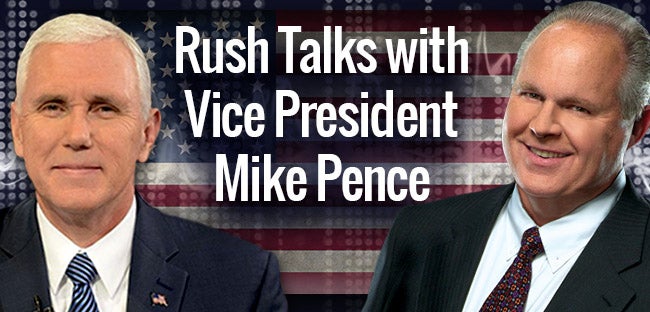 CALLER: Thank you for having me. I’m flabbergasted — and I’m a Trump voter — because you tried to put a dent in the armor of Mike Pence, and he stuck to the talking points on this budget like it was scripted on his part. You couldn’t make a dent in him! I didn’t vote for Trump for this budget that they passed.