"The taxpayer; that's someone who works for the federal government,but doesn´t have to take a civil service examination."
-- Ronald Reagan
 Desiree Fairooz had a hearty LOL during Jeff Sessions' confirmation hearing to be attorney general. Now she's facing misdemeanor charges for "disorderly and disruptive conduct," HuffPost reported Tuesday.
Fairooz is on trial this week in D.C. Superior Court after being arrested by U.S. Capitol Police during the Jan. 10 confirmation hearing for Sessions. Fairooz, an activist with the anti-war protest group Code Pink, burst out laughing when Sen. Richard Shelby (R-AL) said Sessions' record of "treating all Americans equally under the law is clear and well-documented."
HuffPost reports:
Fairooz was seated in the back of the room, and her laugh did not interrupt Shelby's introductory speech. But, according to the government, the laugh amounted to willful "disorderly and disruptive conduct" intended to "impede, disrupt, and disturb the orderly conduct" of congressional proceedings. The government also charged her with a separate misdemeanor for allegedly parading, demonstrating or picketing within a Capitol, evidently for her actions after she was being escorted from the room.
Jason Covert, one of the assistant U.S. attorneys trying the case, asked Officer Coronado on Monday whether the laughter was "loud enough to draw your attention" or if she recalled "seeing other people turning around." Coronado claimed she had seen other people turn around and later said Fairooz had been laughing "very loudly."
HuffPost reported an assistant U.S. attorney even asked the police officer who arrested Fairooz if she thought Shelby's comments were humorous. (The officer said they were not.)
Fairooz said in a statement on Code Pink's website that it was her "responsibility as a citizen to dissent at the confirmation hearing of Senator Jeff Sessions, a man who professes anti-immigrant, anti-LGBT policies, who has voted against several civil rights measures and who jokes about the white supremacist terrorist group the Ku Klux Klan."
Two other protesters who interrupted the hearings dressed in Ku Klux Klan robes are also on trial with Fairooz.
Code Pink has been interrupting hearings on Capitol Hill for more than a decade, and their members have been arrested numerous times. Being prosecuted for allegedly laughing in an inappropriate manner, however, would be a new one. And not a great look for a notoriously thin-skinned administration.
The U.S. Attorney's Office of the District of Columbia could not be immediately reached for comment.
The Stream - Tuesday May 2, 2017
by KEVIN FREKING
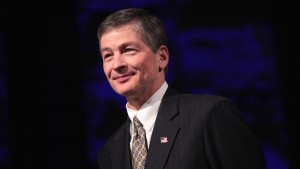
WASHINGTON (AP) -- Republicans who eagerly awaited a GOP president so they could take a heavy knife to many of the regulatory requirements for banks, insurers and other financial institutions finally get their chance.
The House Financial Services Committee, led by Texas Rep. Jeb Hensarling, is slated to begin work Tuesday on legislation to largely undo the Dodd-Frank law, which Congress passed and Democratic President Barack Obama signed after the financial meltdown in 2008.
The GOP argues that the law hurts the economy by making it harder for consumers to get credit to buy a new house or a car, or for entrepreneurs to start or expand a small business. Hensarling has complained that banks are offering fewer credit cards and free checking accounts, while community banks report that compliance with Dodd-Frank’s regulatory burdens make it harder to provide more mortgages.
With Donald Trump in the White House, Republicans are counting on an ally for their effort. Democrats claim that the changes would allow the kind of risky practices that crashed the economy.
Hensarling’s bill would repeal about 40 provisions of Dodd-Frank, targeting the heart of the law’s restrictions on banks by offering a trade-off: Banks could qualify for most of the regulatory relief in the bill so long as they meet a strict basic requirement for building capital to cover unexpected big losses. He says the capital requirements will work as an insurance policy against a financial institution going out of business.
Republicans are likely to pass the measure in the House, but face significant obstacles in the Senate where leaders have emphasized their desire to find areas of agreement to enhance economic growth.
Hensarling also goes after the consumer protection agency that Congress established after the financial crisis, the Consumer Financial Protection Bureau, reducing its powers and making it easier for the president to remove its director.
Hensarling disputed Democratic Rep. Maxine Waters’ assessment that the bill is “dead-on-arrival.”
“I do not consider this to be an exercise in futility,” he told reporters. “I think it is important to move this bill forward, and I think at the end of the day, end of the Congress, we will see major portions of the Choice Act enacted into law.”
Copyright 2017 The Associated Press. All rights reserved. This material may not be published, broadcast, rewritten or redistributed.

Democratic National Committee Chairman Tom Perez spoke at an immigrant and workers rally outside of the White House Monday.
“The Democratic party will always be here, fighting for you,” Perez told the groupMonday afternoon. “The Democratic party is here, fighting for you.”
Perez asserted that the Democratic party and the immigrant community share the same values, centered around diversity. He claimed that “our nation’s diversity is our greatest strength.” He also expressed frustration with the current president, who he would not mention by name.
“Our most important power is not the mister in the White House, I can’t even mention his name, the power is with all of you,” Perez said, before extolling the power of big labor, which was present at the march in solidarity. “No human being is illegal, we must treat everyone with dignity,” Perez continued, as he switched between English and Spanish for the crowd.
The protest outside of the White House, which grew to a few thousand by the dinner hour, was a part of nationwide May Day protests. The day is recognized around the globe as the international version of Labor Day. (RELATED: NY Times: When Communism Inspired Americans)
“We will be fighting for racial justice, economic justice, and moral justice,” Perez said, listing off a plethora of talking points.
Perez said he spent over ten years with Casa Maryland, one of the groups organizing the May Day protest. Perez was approached by The Daily Caller News Foundation with questions but declined to comment.
Send Tips to ted@dailycallernewsfoundation.org.
Content created by The Daily Caller News Foundation is available without charge to any eligible news publisher that can provide a large audience. For licensing opportunities of our original content, please contact licensing@dailycallernewsfoundation.org.

Once again, Congressional Republicans delivered a swift kick to the crotch of their voters, in the form of their proposed budget this week. Congressional big spenders reached a deal Sunday, with a bill over 1600 pages in length. Almost as long as Obamacare. But at least it's a budget. Last year Congress had no budget, instead papering over their fiscal irresponsibility via temporary spending measures.
Since this budget is proposed by the Republican Congress, with the expectation of the Republican President signing it into law, one would reasonably expect that the budget represents Republican priorities. Funding programs promoted on the campaign trail and cutting or eliminating spending which they campaigned against.
What were President Trump's priorities as a candidate? Build the wall. Cut wasteful spending on Planned Parenthood, the Environmental Protection Agency and other financial black holes.
What about Congressional campaign promises? Remember their priorities over the past eight years to rein in out of control spending by Obama and the Democrats? Including Obamacare and trillion-dollar deficits.
In 2010, Republicans told us they needed to win the House before they could repeal Obamacare and advance a conservative agenda. Done. In 2014, they told us they needed the Senate too. Done.
Yet nothing from Congress other than excuses. Afraid of the Obama veto pen, they told us they needed a Republican President to get anything done.
Here we are with a Republican Congress and President and if I didn't know any better, I'd say the Democrats were still in charge.
Photo credit: Michael Key, Washington Blade
Leading Democrats certainly like this week's budget deal. Chuck Schumer happily announced, "This agreement is a good agreement for the American people." Nancy Pelosi was similarly pleased "that Democrats won the removal of about 160 partisan riders." Good to know that leaders of the political party that lost over 1200 elected seats over the past eight years got much of what they wanted in the budget and are pleased.
What about Republicans? What about the voters responsible for sending the Democrat party into exile, a total repudiation of their liberal agenda? Programs that should have been cut or eliminated are funded, all contrary to myriad campaign promises.
What isn't funded? The wall. Trump's signature campaign issue first mentioned during his glide down the escalator at Trump Tower when he announced his candidacy.
Back to my original question. Why bother voting for Republicans? Controlling the legislative and executive branches of the Federal government means nothing. It's as if the Democrats were still in charge. 2008 all over again.
Here we are, 100 days into the Trump administration with a Republican majority not seen in decades. Obamacare hasn't been repealed. Tax reform is nothing but talk. Planned Parenthood and sanctuary cities are funded. And the wall is a wall to nowhere.
It's obvious that Congressional Republicans have no interest in following through on their campaign promises. Or on the major campaign agenda items of their president. Why weren't these bills written and submitted on inauguration day? The Obama stimulus bill was written and ready to go on day one.
Unfortunately for President Trump, he has no allies in Washington, DC. The Democrats loathe him. Same for the bureaucratic deep state, lobbyists and the media. But what about his own party? Those enjoying the electoral majority he helped secure, yet have no use for Trump and his agenda. How can a reasonable person conclude otherwise?
Now what? The ball is now in Trump's court. The White House should write the legislation, rather than the Chamber of Commerce and other GOP donors. Trump could also take a stand and veto this budget, as it doesn't reflect his priorities. Gutsy move but this is a gutsy president.
Send the budget funding sanctuary cities but not a border wall back to Ryan and McConnell to fix. If the government shuts down, so what? Send Congress back to the drawing board, rather than meekly accepting a budget the Democrats and the media are thrilled about.
Otherwise why vote Republican? As Mrs. Clinton said, "What difference, at this point, does it make?"
Brian C Joondeph, MD, MPS, a Denver based physician and writer. Follow him on Facebook, LinkedIn and Twitter.

Enjoy the next five months while you can, because America will soon be entering a "brave new world" in which our fiscal chickens will be coming home to roost. On Oct. 1, 2017 we begin fiscal 2018, and it'll mark the 10-year anniversary of former Speaker Nancy Pelosi's first budget, which saw a deficit of -$458B, the record at the time. A year later, on Oct. 1, 2018, we hit the 10-year anniversary of Madam Pelosi's first trillion-dollar deficit: -$1.4T. Not one to rest on her laurels, Pelosi went on to produce additional trillion-dollar deficits.
Why are these 10-year anniversaries significant? It's because most of the federal debt is in the form of Treasury Notes, i.e. T-notes, whose longest terms are ten years. Which means the insane debt of the last decade will soon be coming due. Look at the nearby screengrab of the chart on page 25 (pdf-28) of the latest "Schedules of Federal Debt" put out by the GAO in Nov. 2016, it shows that fully $8.6T of the $13.6T in marketable publicly-held debt was in Treasury Notes. Also notice that Treasury Bonds, which have twenty and thirty year terms, comprise less than 13.4 percent of marketable public debt.
Over the next decade, the feds will need to roll over, i.e. resell, U.S. debt on a scale that we've never seen. The proverbial pig will start making its way through the proverbial python. But the pig is rather elephantine, so open wide, because you're the python.
Adding to this we have the periodic spectacle of the "debt ceiling." Some ceiling that is, as Congress always busts right through it to ascend to ever-higher debt. (They should rename it the "debt speedbump.") Democrats have made not raising the debt ceiling into some unthinkable betrayal, a shirking of one's duty as a public servant. It's as though not going further into debt is treasonous. Our looming debt repayment dilemma would be bad enough if the budget were balanced, but Congress is still running a huge deficit. In the debt ceiling brouhaha of 2011 there was even talk of minting a "trillion-dollar coin." (Heck, why not just mint a quadrillion-dollar coin and be done with the debt ceiling for a while?)
Some say "deficits don't matter." We own the world's reserve currency, after all, which allows us more latitude than EU nations, like Greece. And we can create money "out of thin air"; the Fed did that for years with Quantitative Easing. But we've had a stagnant economy despite throwing trillions of dollars at it in deficit spending and QE. We may have done little but postpone the unpleasant.
On March 11, the Manhattan Institute ran "Higher Interest Rates Could Explode Budget Deficits and Our National Debt" by Brian Riedl:
First, the Federal Reserve is expected to continue phasing out its policy of keeping interest rates extraordinarily low, meaning rates should normalize over the next few years.
Second, interest rates have been constrained by the weak recovery that followed the Great Recession. If the economy eventually returns to its more typical 3.0 to 3.5 percent growth rate, demand for business, auto, and home loans should go up, thus raising interest rates.
Finally, and most importantly, the soaring national debt will eventually push interest rates significantly higher, because added demand raises prices. With the national debt in the process of rising $20 trillion over 20 years, all of Washington's new borrowing represents a historic increase in the demand for savings, resulting in higher interest rates for the government (as well as for families and businesses).
Up until now, the Federal Reserve and the weak economy have counteracted the interest effects of this new debt, saving taxpayers $1.3 trillion in lower national-debt-interest payments since 2009. But as the Federal Reserve tightens its policies, economic growth (hopefully) picks up, and the national debt continues surging, all signs suggest interest rates will be significantly higher down the road.
Nancy Pelosi was never able to get the deficit back below a trillion dollars before she lost the speakership. The four budgets that Speaker Pelosi oversaw produced the largest deficits ever, and the bulk of that debt starts coming due on Oct. 1 this year. That Democrats still have that ridiculous woman as their leader is testimony to the dystopian decadence of their party. Pelosi may not be the most destructive speaker ever, but she is surely the most expensive. So it's a bit rich when she says of the border wall that it is "immoral, expensive, and unwise."
If the federal government does not begin to have a "fiscal reckoning" within the next five years, then it may never happen. In which case, we'll need to consider if we live in some "monetary Matrix" where nothing's real, (call it "Krugmania"). But however tenuous its existence might be, I'm betting that money does have some kind of reality, and that its reality is going to bite us soon.
On March 4, NRO ran George Will's "Slouching into Dystopia," a review of The Mandibles, a new novel by Lionel Shriver that puts our fiscal reckoning in 2029. That's the year of an "economic crash and the Great Renunciation, whereby the nation, like a dissolute Atlas, shrugged off its national debt."
If you're one of those who believe "deficits don't matter," then read Will's short review. Also, in a wide-ranging Reasonmagazine interview, Shriver summed up her new book: "The focus of the novel is the implosion of the economy as a consequence of overloading of U.S. sovereign debt." Interviewer Katherine Mangu-Ward asked Shriver, "I was struck by the idea that complex systems collapse catastrophically. Is our economy such a system?"
I think so. It almost collapsed in 2008. We think that we went through a catastrophe at that time and we didn't. We propped everything up. But I think that there are all kinds of signs that we have simply -- the British use this expression incessantly -- kicked the can down the road. I think that the bullet we dodged in 2008 is still whizzing around the planet and is going to hit us in the head. When the currencies aren't worth anything and the stock market is crashed, what's left?
The nifty thing about balanced budgets is that they force decisions about what's important, they force prioritizing. But Congress hasn't had to prioritize, because with debt and the Fed's money creation, they don't need to make tough decisions, they can have it all. Despite our coming debt difficulties what do we hear coming from D.C.? We hear that economic growth will balance the budget; growth first, budget later. What we're not hearing much about is cutting spending, for that would entail decisions. But there isn't much road left for can kicking.
Our D.C. politicians need to think bigger. They need to think about doing two things that some think exclude each other. Our D.C. politicians need to think about a "fiscal Moon Shot": We choose to simultaneously balance the budget and revive the economy, not because it is easy, but because it is right.
Jon N. Hall of Ultracon Opinion is a programmer/analyst from Kansas City.
The Stream - Tuesday May 2, 2017
by KEVIN FREKING
WASHINGTON (AP) -- Republicans who eagerly awaited a GOP president so they could take a heavy knife to many of the regulatory requirements for banks, insurers and other financial institutions finally get their chance.
The House Financial Services Committee, led by Texas Rep. Jeb Hensarling, is slated to begin work Tuesday on legislation to largely undo the Dodd-Frank law, which Congress passed and Democratic President Barack Obama signed after the financial meltdown in 2008.
The GOP argues that the law hurts the economy by making it harder for consumers to get credit to buy a new house or a car, or for entrepreneurs to start or expand a small business. Hensarling has complained that banks are offering fewer credit cards and free checking accounts, while community banks report that compliance with Dodd-Frank’s regulatory burdens make it harder to provide more mortgages.
With Donald Trump in the White House, Republicans are counting on an ally for their effort. Democrats claim that the changes would allow the kind of risky practices that crashed the economy.
Hensarling’s bill would repeal about 40 provisions of Dodd-Frank, targeting the heart of the law’s restrictions on banks by offering a trade-off: Banks could qualify for most of the regulatory relief in the bill so long as they meet a strict basic requirement for building capital to cover unexpected big losses. He says the capital requirements will work as an insurance policy against a financial institution going out of business.
Republicans are likely to pass the measure in the House, but face significant obstacles in the Senate where leaders have emphasized their desire to find areas of agreement to enhance economic growth.
Hensarling also goes after the consumer protection agency that Congress established after the financial crisis, the Consumer Financial Protection Bureau, reducing its powers and making it easier for the president to remove its director.
Hensarling disputed Democratic Rep. Maxine Waters’ assessment that the bill is “dead-on-arrival.”
“I do not consider this to be an exercise in futility,” he told reporters. “I think it is important to move this bill forward, and I think at the end of the day, end of the Congress, we will see major portions of the Choice Act enacted into law.”
Copyright 2017 The Associated Press. All rights reserved. This material may not be published, broadcast, rewritten or redistributed.


